Businesses are investing in tools like ChatGPT, Microsoft Copilot and other AI platforms with the expectation that they will save time, improve productivity and change the way work gets done.
But providing access to AI doesn’t mean it will be adopted effectively.
We help you understand what’s really happening across your business and what needs to happen next.to make AI part of everyday work.
Because successful AI adoption isn’t just about technology. It’s about people.
Buying licences is easy. Helping people confidently use AI in their everyday work is where the challenge begins. AI is everywhere. Adoption isn’t.
Many businesses have already invested in AI tools such as ChatGPT, Microsoft Copilot or Claude.
But months later they’re still asking:
The reality is that most AI initiatives fail because of people, not technology.
Without clear guidance, practical use cases and ongoing support, employees often don’t know where to start. Others experiment briefly before returning to old ways of working.
Successful AI adoption requires more than training. It requires leadership, capability building, knowledge sharing and sustainable change.
AI is changing the way work gets done.
Businesses that build capability now will be better placed to improve productivity, reduce administrative workload and adapt as AI continues to evolve.
Those that delay risk falling behind as competitors become faster, more efficient and more innovative.
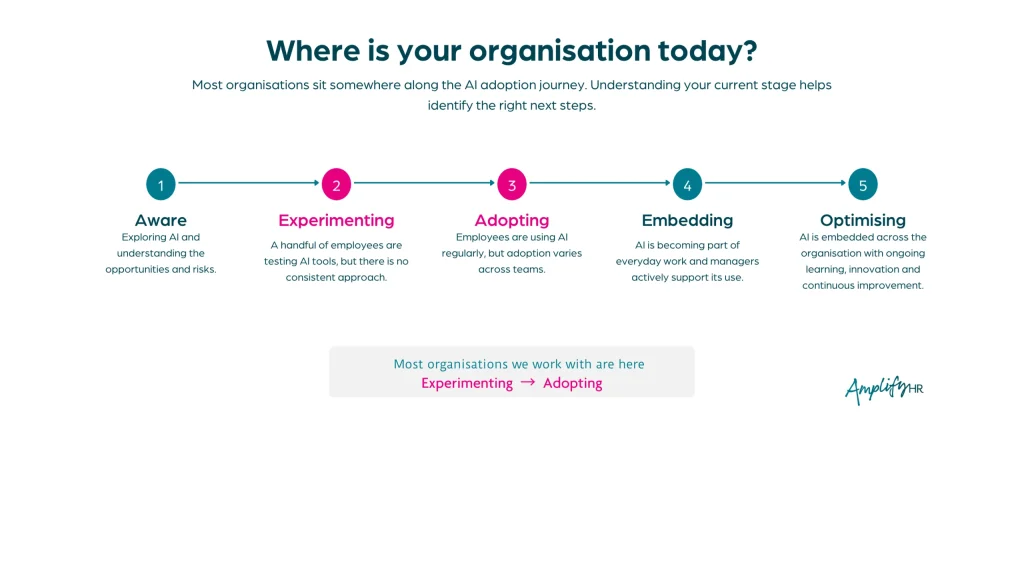
Where is your organisation today?
Most AI providers focus on tools, prompts and technology.
We focus on people.
Our expertise is helping organisations navigate change, build capability and create new ways of working.
That means we help you identify how to help your team team:
Build confidence
Develop sustainable habits
Measure impact
Because successful AI adoption is ultimately a people challenge.
An evidence-based assessment of how effectively AI is being adopted across your organisation — and what you should focus on next.
$4,800 + GST For organisations up to 50 employees. Larger organisations scoped separately.
Rather than jumping straight into more AI tools, training or automation, start by understanding what your organisation actually needs.
Our AI Adoption Assessment brings together leadership and employee perspectives to identify what’s working, what’s getting in the way and your next steps.
Ideal for organisations that:
We assess whether leaders are clear on why AI matters, what they want it to achieve and how they are supporting adoption.
We assess employee confidence with practical AI skills and understanding of appropriate use.
We assess how consistently AI is being used and what’s getting in the way.
We assess manager support, experimentation and how effectively AI learning is shared.
We assess whether AI is improving efficiency, ways of working and business value.
Members of your leadership team individually assess the organisation’s current AI adoption, giving us an initial picture of leadership perceptions and alignment.
Your employees share their experience of using AI, including confidence, capability, current adoption, learning and support, and perceived business value.
We analyse your results across five key dimensions — Leadership, Capability, Adoption, Learning & Change and Business Value — highlighting strengths, gaps and priority areas.
We bring together leadership and employee perspectives to identify what’s working, what’s holding adoption back and where further attention is likely to create the greatest value.
A facilitated session to explore your business priorities, what you want AI to help you achieve and the organisational conditions needed for successful adoption. We also take your leadership team through the survey findings, explore the key issues and agree on the priorities and appropriate next steps.
A practical, evidence-based plan showing where your organisation is today and what should happen next. It contains clear recommendations based on what the Assessment finds and a focused set of actions for the next 90 days.
Identify where employees need practical skills and support.
Understand what’s preventing AI from becoming part of everyday work.
Understand what you’re trying to achieve through AI adoption.
Clarify what AI value should look like and how you could measure it.
Turn individual learning into organisational capability.
Identify where employees need greater clarity about safe and appropriate use.
Understand whether Champions could help accelerate learning and adoption.

Know what to address internally, and where specialist expertise may be required.
It is common to see small and medium-sized businesses invest in AI tools like Microsoft Copilot, but a year later, employees are still unsure how to use them, managers aren’t actively supporting adoption, and leadership doesn’t have a clear picture of the value AI is creating.
Through the AI Adoption Assessment you’ll understand:
If leaders are providing the clarity and support needed for AI adoption
How confident and capable your employees are in using AI
Whether AI is actually being used — and what’s getting in the way where it isn’t
If useful AI learning is being shared across the organisation or staying with individuals
Whether AI is creating meaningful business value
Where your biggest adoption gaps are and what to prioritise next
That’s the difference between providing AI and building the conditions for successful AI adoption.
No. We work with organisations that are just getting started as well as those looking to improve adoption and increase value from existing AI investments.
We focus on adoption rather than specific platforms which means wed can support organisations using ChatGPT, Microsoft Copilot, Claude, Gemini and other approved tools.
No. We focus on the people side of AI adoption. The AI Adoption Assessment identifies what may be helping or holding back AI adoption across your organisation.
Typically between 4 and 6 weeks depending on the availability of the leadership team.
We assess whether AI is improving efficiency and the way work gets done, and identify practical measures to help you track its impact over time.